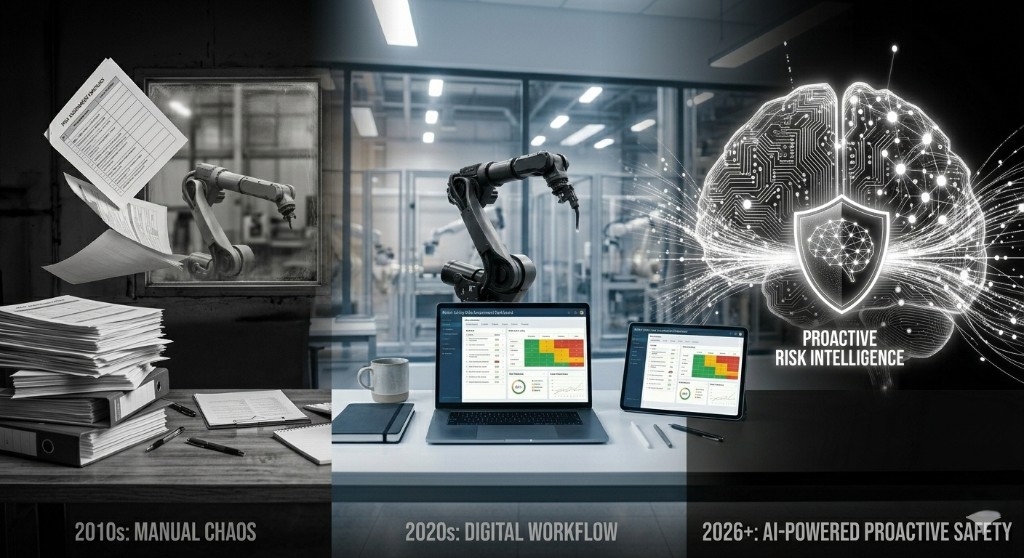
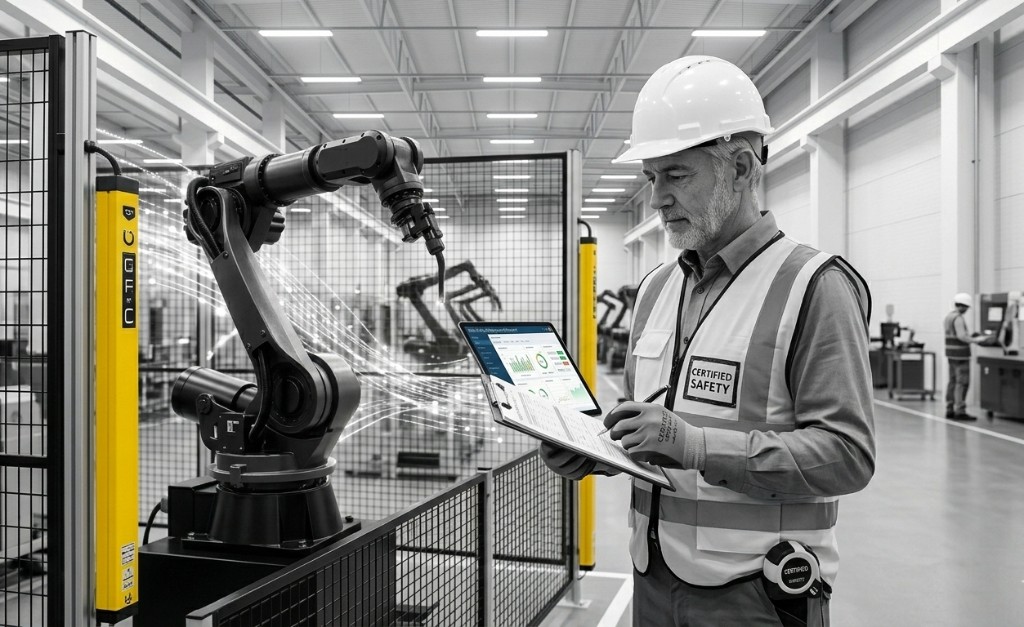
Our newest capability layer applies machine learning to your historical assessment data, global standards knowledge, and real incident databases to make your safety program smarter over time.
Explore AI Features →
AI pre-populates likely hazards based on task type, robot model, and industry, cutting assessment setup time by up to 50%.
Contextual safeguard suggestions cross-referenced with applicable clauses from application specific current standards.
Ask questions like "What safeguards are needed for a cobot assembly station?" and get expert-calibrated guidance instantly.
Aggregate intelligence across your facilities to identify patterns, benchmark safety maturity, and prioritize remediation efforts.
From hazard identification and performance level determination to Functional Safety Calculations and validation, the complete risk assessment lifecycle.
Explore more ↓

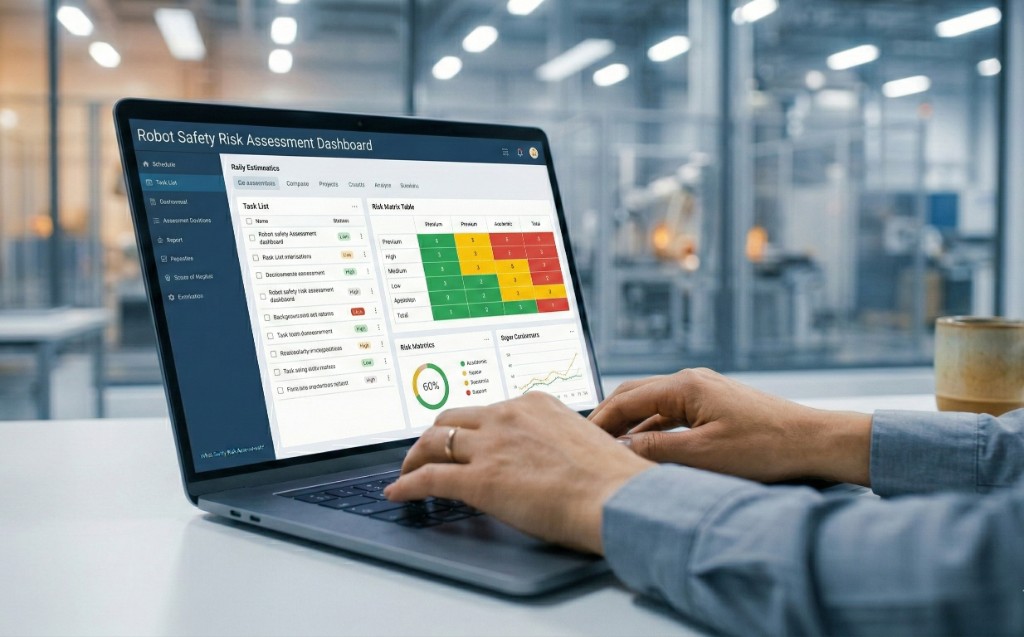
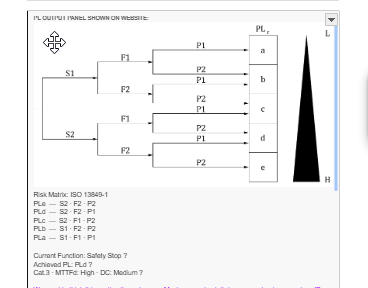
Identify every task performed around your robot or machine, associate hazards, assign severity and exposure, and select appropriate safeguards, all in a guided workflow aligned, compliant with ISO 12100, ANSI B11.0 and A3 Robotics TR R15.306.
In-depth functional safety calculations with AI-assisted PL and Category determination. Build a custom component library from your specific safety devices and manufacturers.
Built-in validation checklist confirms your safeguards meet required performance levels. Track verification progress across every task with live status indicators.
Generate professional risk assessment reports for OEMs, integrators, or compliance reviews. Full history trail tracks every change, ensuring accountability and audit-readiness.
Share assessments with integrators, consultants, and team members across facilities. Control access with granular share/unshare permissions, keeping proprietary data protected.
Deploy a standardized risk assessment process across every facility in your enterprise. Templates, preloaded task and hazard libraries, and consistent methodology at every location.
The definitive platform for robot, machine, and automated system safety. Reduce risk to acceptable levels through structured, standards-compliant task-based assessments, now supercharged with AI.
Five structured steps based on ISO 12100 iterative risk reduction methodology.

Based on your entire plant layout, start adding lines, areas, or zones to structure your system risk assessment plan.
What puts them at risk, start adding tasks involved with the risk assessment.
First evaluate risks, it is worthwhile ranking them once identified.
Evaluation or physical testing of components to confirm they meet the requirements of the safety functions.
Validate built machine to confirm that safety functions perform as designed to meet the requirements of the risk assessment.
From automotive OEMs to pharma cleanrooms, RSC adapts to your specific safety program, application type, and team structure.
Full lifecycle risk assessments for 6-axis robots, from installation through decommissioning. Compliant with ISO 10218 and ANSI/A3 R15.06.
ISO/TS 15066 compliant assessments for all four human-robot collaboration modes: speed and separation monitoring, safety-rated monitored stop, power and force limiting, and hand-guiding, with force limit evaluation.
Mobile robot risk assessments aligned with RIA TR R15.306. Covers travel paths, loading stations, fleet interactions, and shared zones.
Standardized multi-plant assessments for high-volume robot cells, audit-ready for OSHA, ISO, and IATF 16949 compliance reviews.
Manage risk assessments across multiple client projects. Share with end-users, reuse templates, and deliver professional compliance documentation.
Standardize the risk assessment process across every facility. Track completion, generate audit reports instantly, and prove compliance to leadership.
Hear from the engineers, integrators, and EHS managers using RSC every day.
"Before RSC, our risk assessments were scattered across spreadsheets and binders. Now every plant runs the same process. Audit preparation that used to take days takes hours."
"The Functional Safety integration alone is worth it. We can verify PL requirements and generate documentation-ready reports without ever leaving the platform."
"The collaboration features are a game-changer for integrator projects. We share assessments with our clients in real-time and everyone stays aligned on requirements."
Safety Center was founded with one mission: make structured, standards-compliant risk assessment as easy and accessible as possible for every safety team, at every facility.
Robot Safety Center was founded by Sarang Panse, an industrial automation and robot safety expert who witnessed firsthand how safety professionals struggled with inconsistent spreadsheets, disconnected processes, and the overwhelming complexity of standards compliance. He set out to solve it, permanently.
The result is a cloud-native, subscription-based platform that structures the entire ANSI/A3 task-based risk assessment process into a consistent, repeatable workflow. After 10+ years and continuous improvement guided by ANSI/A3 committee members and client feedback.
Dan Junker, the Co-Founder of RSC, is a member of the following committees: A3 Robotics Standards Committees, including R15.06, R15.08, and occasional sub-committees. UL Robotics Technical Panels, including 1740, 3300, 3100, and 4600. R15 SAC and/or U.S. Technical Advisory Group (TAG) to ISO TC 299, and A3 International Government Advocacy Committee. With client feedback, RSC has become a cornerstone tool for Fortune 500 manufacturers, integrators, and OEMs worldwide.
We remain entirely focused on making risk assessment efficient, and with our new AI capabilities, we're entering a new era of intelligent, proactive safety management.


Every feature, every workflow, every output is grounded in ISO, ANSI/A3, and IEC standards. We don't take shortcuts, compliance is the foundation, not an afterthought.
Anyone who can use a browser can use RSC. We designed the platform for participation, from front-line operators to corporate EHS leads, building shared ownership of safety.
Safety standards evolve. So do we. Lessons learned from ANSI/A3 committee participation and real-world client deployments continuously improve every aspect of the platform.
Cloud-native architecture means your safety data is always available, on your laptop, tablet, or phone, at the office or on the floor. No installs, no version conflicts.
Connected with around a hundred plus safety consultants worldwide. When you need specialized expertise, we can match you with the right professional for your industry and application.
We deliver measurable results, reduced assessment cycle time, improved compliance rates, lower incident risk. Clients report around 40% faster audit preparation. Safety investment that can be monitored and proven to leadership.
Speak directly with our safety experts and see the platform in action.
From initial task documentation to final validation sign-off, every step of the ANSI/A3 risk assessment lifecycle lives in one structured, cloud-based platform.
RSC structures the ISO, ANSI, A3 task-based methodology into a guided workflow. Document every task (I.E. assembly, programming, setup, normal operation, maintenance, teaching, troubleshooting) and associate them with specific hazard types from our preloaded libraries primarily referencing standards and prior work.
| Task | Hazard | Severity | PL Req. | Status |
|---|---|---|---|---|
| Teaching | Unexpected mvmt | S2 | PLd | Done |
| Load/Unload | Reach-over crush | S1 | PLc | In Progress |
| Maintenance | Unexpected energization | S2 | PLd | Open |
| Fault Recovery | Panel access | S2 | PLd | Open |
| Cleaning | Pneumatic gripper pinch | S1 | PLb | Done |
In-depth functional safety calculation support directly within the platform. Determine Performance Levels and Category classifications for your safety functions without switching tools.
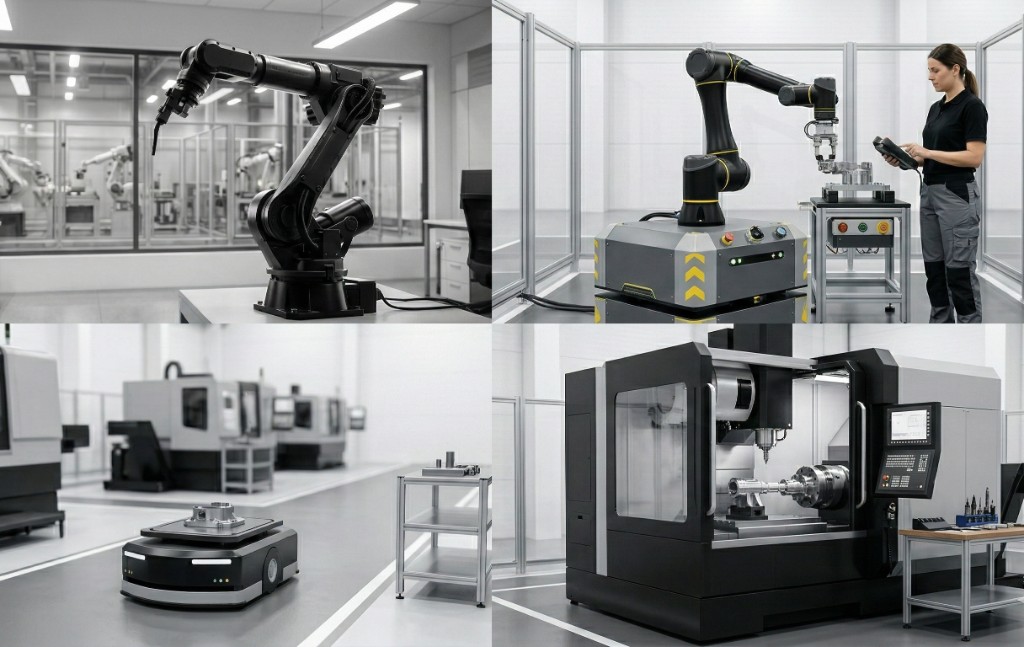
RSC handles the full spectrum of modern industrial automation, including but not limited to: machines, robots, collaborative applications, autonomous platforms and robots, material handling, and many processes.
Full compliance with ISO 10218-1/2 and ANSI/A3 R15.06. Covers all tasks from installation through decommissioning for 6-axis and SCARA systems.
Click to flip backAs robots and humans increasingly share the same workspace, the approach to safety assessment is evolving. Collaborative applications cover any scenario where a person and an automated system operate in close proximity — whether the robot stops, slows, or continues moving based on human presence.
The level of protection required depends on the specific interaction — the forces involved, how close the operator gets, how often, and whether contact is possible. RSC guides you through evaluating each of these factors systematically, selecting appropriate safeguards, and documenting your assessment in line with current standards.
This area of safety is developing rapidly. RSC is designed to adapt as guidance and best practices continue to evolve.
Click to flip backRIA TR R15.306 compliant. Evaluate mobile robot travel paths, interaction zones, loading stations, and fleet management safety architectures.
Click to flip backFull ANSI B11.0-2020 and ISO 12100 support for presses, CNC equipment, conveyors, palletizers, and any automated machine or processing equipment.
Click to flip backAssess complete production lines, cells, and systems where robots, machines, and material handling interact, with system-level safeguard planning.
Click to flip backEmerging framework for AI-integrated robots and autonomous systems. Assess additional hazards from perception failures, edge-case behaviors, and adaptive control.
Click to flip backOur team will walk you through a live demo using your actual robot or machine type.
We're bringing artificial intelligence directly into the risk assessment workflow, making every step faster, smarter, and more consistent across your entire safety program.
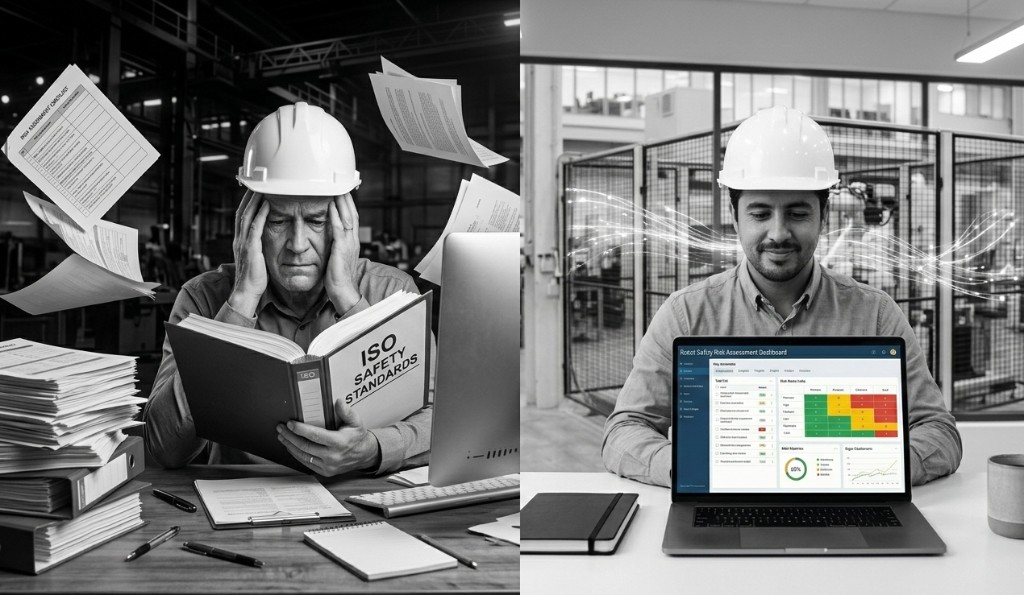
Risk assessment quality depends heavily on the experience of the person performing it. AI closes the knowledge gap, ensuring every assessment benefits from the collective expertise of thousands of assessments, real-world incidents, and global standards knowledge.
Ask questions in plain English and receive expert-calibrated, standards-referenced answers. The assistant understands your facility's specific context, robot model, application type, installed safeguards, to give you directly applicable guidance.
Aggregate AI intelligence across your entire safety program, across plants, departments, and time. Identify recurring hazard patterns, benchmark safety maturity against industry peers, and prioritize where to focus remediation effort.
As AI is integrated into robots and automated systems themselves, new categories of hazards emerge. RSC is building the framework to assess them.
Assess risk from computer vision errors, LiDAR blind spots, and sensor degradation in AI-driven navigation and manipulation systems.
Document and evaluate risks from self-learning robot behaviors that may deviate from originally validated operating parameters.
Structure assessments for out-of-distribution scenarios where AI models may make unexpected decisions, and define safe failure modes.
Assess risks from adversarial inputs, model poisoning, and unauthorized modification of AI safety functions in connected robot systems.
Track model versions, retrain events, and deployment changes as life-cycle phases requiring risk re-evaluation, aligned with ISO 10218 principles.
Stay ahead of evolving AI safety regulations, ISO/IEC TR 5469, EU AI Act implications for industrial systems, and NIST AI RMF alignment.
Join our beta program and help shape the future of AI-assisted safety assessment.
Beyond the software, RSC provides expert training, onsite consulting, and a global network of certified safety professionals to support every stage of your safety program.
Cloud-based, subscription platform for structured risk assessments aligned with ANSI/A3 and ISO standards. Includes preloaded task, hazard, and safeguard libraries; Functional Safety Calculations; real-time validation; and audit reporting. Deployable across all your facilities with a consistent methodology.
Online or onsite training delivered by certified safety experts (TÜV Nord CMSE). Learn the full task-based risk assessment methodology, from hazard identification through Functional Safety verification. Training is available for up to 10 users per session and can be application-specific to your industry and equipment type.
Don't have the internal bandwidth? Our certified safety professionals will perform your robot or machine risk assessment for you, on-site, following the same rigorous methodology enforced in our software. Deliverables include a complete assessment report and recommendations package.
Rolling out a consistent risk assessment process across a multi-plant operation requires more than software, it requires change management, process design, and training coordination. We deliver structured implementation programs that get every facility aligned and equipped to execute.
Safety assessments don't happen in isolation. RSC enables machine builders, system integrators, and end-user facilities to collaborate in real-time on shared assessments, with access controls that protect proprietary information while enabling efficient joint review.
Every organization has unique equipment types, terminology, and workflow requirements. Our software consulting team helps you customize RSC to match your specific needs, preloading your equipment, configuring your terminology, and building out templates that reflect your actual safety program structure.
Talk to our team and we'll recommend the right starting point for your safety program.
onetime setup, unlimited assessments, and bi-weekly expert support calls included. All plans come with a 30-day money-back guarantee.
A plant refers to a single physical facility or manufacturing location. Multi-plant enterprise pricing is available for organizations managing safety programs across multiple sites.
onetime onboarding includes account configuration, library customization, and a software training session for your team to get you running confidently from day one.
Yes. Additional users can be added at any time for $599.99/year (Unlimited plan) or $499.99/year (Basic plan) per user.
Yes. If you're not satisfied within 30 days of subscribing, contact us for a full refund, no questions asked.
See how safety teams across manufacturing, logistics, pharmaceuticals, and automotive rely on Robot Safety Center to protect workers and maintain compliance, whatever their application.
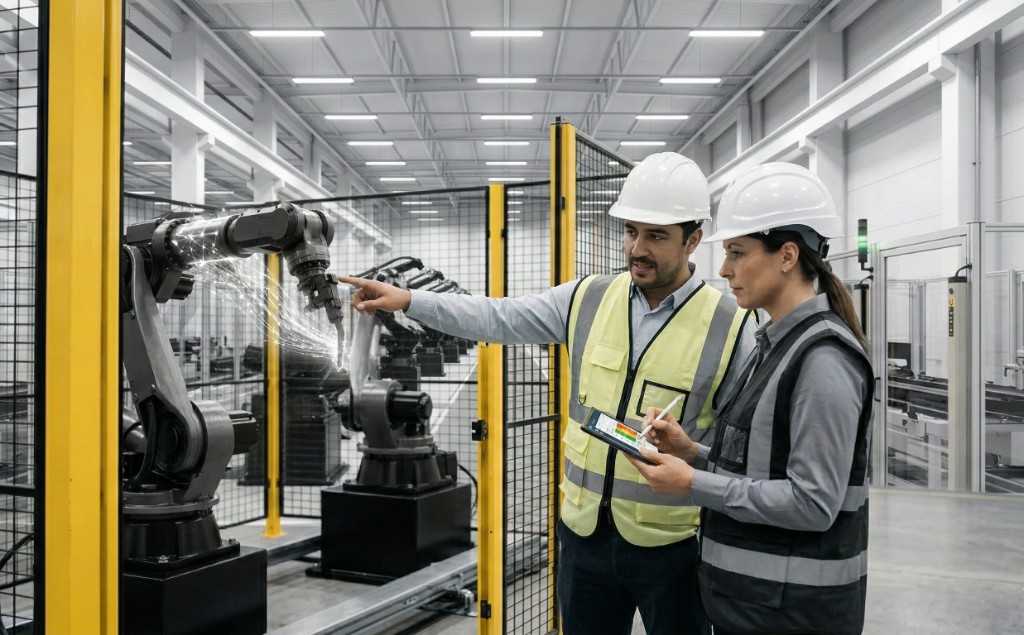
High-speed, high-force 6-axis robots require comprehensive task-based assessments covering every life-cycle phase, installation, programming, maintenance, fault recovery, and decommissioning. RSC provides preloaded task libraries, Performance Level determination, and Functional Safety calculations built in.
Collaborative applications involve people and automated systems working in close proximity, often sharing the same workspace. RSC guides you through assessing these scenarios in line with current standards, with clear documentation of hazards, safeguards, and verification steps.
Mobile robots navigate shared human spaces, requiring assessment of travel paths, loading and unloading stations, intersection zones, and fleet-wide interaction scenarios. RSC provides RIA TR R15.306 aligned templates for complete mobile system documentation.
From CNC machining centers and presses to conveyors and palletizers, RSC handles full machine risk assessments under ANSI B11.0 and ISO 12100, with safeguard selection, Functional Safety calculations, and complete validation documentation.
Multi-plant standardized assessments for high-volume robot cells, audit-ready for OSHA inspections, ISO certification, and IATF 16949 compliance. Covers welding robots, press automation, assembly cobots, and paint shop systems.
Robotic palletizers, case packers, and filling lines in wet, wash-down environments. RSC covers cleaning and changeover tasks, hygienic guarding options, and high-frequency operator access scenarios.
FDA validation-ready documentation, ISO 14971 risk management alignment, and cleanroom robot assessments structured for quality system integration and regulatory review.
Mixed fleets of AMRs, robotic picking arms, conveyor networks, and AS/RS systems operating alongside large workforces. RSC provides multi-system assessment capability and zone-based interaction mapping.
Complex, low-volume high-mix aerospace manufacturing with large robot systems and rigorous AS9100 documentation requirements. RSC supports drilling, fastening, and MRO inspection robot assessments.
Whether you run a single automated cell or a fully integrated production line, RSC scales to your operation, with preloaded libraries, templates, and standards support for any manufacturing application.
Standardize the risk assessment process across every plant. Track assessment completion status in real time, generate audit-ready reports instantly, and give leadership clear visibility into your safety program maturity.
Manage risk assessments across multiple simultaneous client projects. Share assessments with end-user clients for review, reuse templates across similar system types, and deliver professional compliance documentation at project handoff.
Deliver CE-marked or OSHA-compliant machinery with complete, standards-aligned risk assessment documentation. Build reusable hazard and safeguard libraries per machine type to accelerate every new project.
Conduct and deliver professional risk assessments for multiple clients using one organized platform. Collaborate with client teams during the assessment, deliver branded professional reports, and access our global consultant network.
Our AI Risk Intelligence layer opens up entirely new capabilities, making your safety program smarter, faster, and more consistent over time.
AI pre-populates probable hazards based on task type, robot model, and industry, with confidence scores. Cuts assessment setup time by up to 50% and dramatically reduces missed hazards for junior safety engineers.
Aggregate intelligence across all your facilities identifies recurring hazard patterns, benchmarks safety maturity, and surfaces proactive remediation priorities for EHS leadership across your entire portfolio.
New framework for assessing AI-specific hazards, perception system failures, adaptive behavior risks, edge-case scenarios, and AI lifecycle change management. Stay ahead of emerging standards including ISO/IEC TR 5469 and EU AI Act requirements.
Talk to our team, we've helped assess everything from surgical robots to automated storage systems. We'll find the right starting point for your specific safety program.
Connected with 100+ safety consultants worldwide. Ask us about specialized consulting in your industry, we'll connect you with the right expert.
We typically respond within one business day.
Your information is kept private and will never be shared with third parties.